Showing posts with label Academic Research and Publication. Show all posts

Saturday, 25 February 2017

Pacific islanders may carry the DNA of an unknown human species: Genetic study reveals ancient Melanesians interbred with a mysterious hominid

By RYAN O'HARE FOR MAILONLINE 

Islanders in the Pacific Ocean may be may be carrying traces of a long lost human species locked up in their DNA. Today, modern humans inherit a small chunk of our genes from Neanderthals, with evidence that some of us carry the genetic remnants of a lesser known sister group, called the Denisovans. But genetic analysis of people living in modern Melanesia suggests they carry traces of a third, as yet unidentified prehistoric relative distinct from the others.

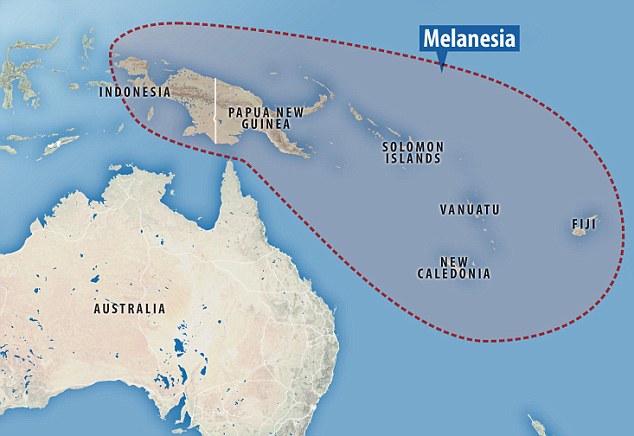
The island groups of Melanesia – which includes Papua New Guinea, Fiji and the Solomon Islands and others – are geographically cut off by the Pacific Ocean, with their DNA providing a unique window into how human ancestors spread across the region. The latest research, presented at a meeting of the American Society for Human Genetics in Vancouver, bolsters previous findings that there may be another strand to the story of modern humans, with multiple groups of prehistoric human interbreeding.

Genetic analysis of Europeans, Asians and others with non-African descent hints that ancient humans interbred with Neanderthals. Some groups inherited as much as four per cent of their DNA from these extinct human cousins. A single finger bone and a few teeth found in a cave in Russia revealed another branch of the family tree, the Denisovans, also left their genetic calling card in modern humans, accounting for as much as four percent of people's DNA in Melanesia.
Native people from Papua New Guinea in Melanesia are believed to owe between two and four per cent of their DNA to Denisovans and carry less Neanderthal DNA than other Asians. But genetic data reveal their ancestors may have bred with a third species of ancient human

Now, the latest number crunching has revealed another genetic twist in the tale of modern humans. Ryan Bohlender, a geneticist at the University of Texas, and colleagues looked at the rate of genetic mixing which would account for what;s seen in modern Melanesians and found that something didn't add up. As expected, their analysis found the genetic calling cards of Denisovans and Neanderthals, but it also revealed a high proportion of other extinct ancestry unaccounted for. To explain this mystery DNA, the team believe that ancient Melanesians must have bred with a third group of hominids. Presenting their findings in Vancouver, the team explained: 'We suggest that a third archaic population related more closely to Neanderthal and Denisova than to modern humans introgressed into the San genomes studied here'. 

By working out the amount of DNA shared by Neanderthals and Denisovans, they calculated that this third extinct human species likely branched off from their common ancestor 440,000 years ago. 'Overall, our findings confirm the human family tree is more complicated than we think it is,' said Dr Bohlender. He exlained: 'Other archaic populations are likely to have existed, like the Denisovans, who we didn't know about except through genetics.' Previous studies have shown that ancient Melanesians’ trysts with Denisovans may have helped them to adapt to new environments and spread across the Pacific and into Australia. Among the Denisovan genes are those which boost resilience to viruses and provide metabolic benefits, including increasing blood glucose levels and breaking down fats. Tracing the genetic lineage has revealed that modern humans interbred with Neanderthals a number of times and Denisovans at least once, before these two human cousins died out.


Read more on this link: http://www.nytimes.com/2008/01/18/world/asia/18islands.html / https://phys.org/news/2007-05-theory-modern-humans-descended-small.html / http://gousnews.com/scientists-shocked-as-they-find-melanesians-carry-dna-of-an-unknown-human-species/ / https://www.ancestry.com/dna/ethnicity/melanesia / https://www.amoeba.com/blog/2010/09/eric-s-blog/out-of-africa-austro-melanesian-history-culture-and-music.html / http://diasporicroots.tumblr.com/post/15811093328/the-melanesians-humans-have-been-leaving-africa / http://www.janesoceania.com/melanesia_origins/index.htm http://www.ancient-origins.net/news-evolution-human-origins/evidence-unknown-extinct-human-relative-found-dna-study-melanesians-02147 / http://www.sciencealert.com/pacific-islanders-appear-to-be-carrying-the-dna-of-an-unknown-human-species / http://ufoholic.com/forbidden-history/lost-children-anunnaki-confirmed-melanesian-tribes-dna-carries-genes-unknown-species/

Black and Blond – The Origin of Blonde Afros in Melanesia

By SUMITRA

About a quarter of the Melanesian population in the Solomon Islands archipelago has an extremely unusual trait -- dark skin with blond hair. The archipelago, located east of Papa New Guinea in Oceania, consists of a thousand islands inhabited by over half a million Melanesian people. They have the darkest skin in the world outside of Africa, but strangely, about one-fourth of the inhabitants sport blond afros.

This rare Melanesian characteristic has baffled scientists and genetic experts for years. Up until now, they have attributed the trait to inheritance -- from the Europeans, especially the British, German and Australians, who have been associated with the island for hundreds of years. Several of the islands were under German jurisdiction in the 19th century. In 1893, the UK took southern Solomon Islands under their wing, declaring the region a protectorate. The rest of the islands were added to the protectorate at a later stage. And in the early 20th century, Australian and British companies set up coconut plantations on many of the islands.

Blondie's from Papua New Guinea & Solomon Islands 
So it isn't entirely unbelievable that the dark-skinned Melanesians got their blond hair from the growing influx of 'outsiders'. The locals, however, prefer not to go by that theory. They have been insisting for years that their blond hair is a result of a diet rich in fish and constant exposure to the sun. As it turns out, both theories are quite far from the truth. According to a recent investigation, random mutation might actually be the answer to the mystery of the Melanesian blonds.

Sean Myles, the author of the study and geneticist at Nova Scotia Agricultural College, pointed out that there is almost no variation in the shades of blond hair. This suggests that the hair color is governed by genes. "It looked pretty obvious to me that it was a real binary trait," he said. "You either had blond hair or you didn't." To locate this underlying blueprint in the Melanesian genetic pool, Myles and his colleagues collected saliva and hair samples from over 1,200 Solomon Islanders. From these samples, they compared the genetic makeup of 42 dark-haired and 43 blond islanders.

What the scientists discovered was pretty phenomenal -- the two groups possessed very different versions of a crucial gene, TYRP1, which coded for a protein involved in pigmentation. Just switching one letter of the genetic code (a 'T' instead of a 'C'), marked the difference between dark hair and blond hair. Only one amino acid in the protein is different (arginine replaced by cysteine). So 25 percent of the Solomon islanders carry two copies of the mutant recessive gene. That means the blonds could have inherited their hair color from both parents. "It's a great example of convergent evolution, where the same outcome is brought about by completely different means," said Myles.

Jonathan Friedlaender, an anthropologist at Philadelphia's Temple University, explained that the mutation probably arose by chance in one individual. It appears to have gained in frequency because the original population of the island was pretty small. Myles added: "If you can find a gene for blond hair that exists in Melanesia and nowhere else, then there's no reason why those sorts of genes don't exist all over the world in underrepresented populations, and affect not only hair pigmentation, but also disease-related traits."

The study also traced the origins of the Melanesian people in an effort to understand the mutant gene. They discovered that while all humans outside of Africa have genes passed down from the Neanderthals, Melanesians are the only known humans with a different prehistoric ancestry. They are believed to have evolved from an interbreeding of the Denisova hominin, Neanderthal man's distant cousin. So the islanders have slightly different genes, which gives them their unique blond hair.


Sources: http://www.odditycentral.com/news/black-and-blond-the-origin-of-blond-afros-in-melanesia.html
Read more on this link: http://www.sciencemag.org/news/2012/05/origin-blond-afros-melanesia http://blackgirllonghair.com/2012/05/black-people-with-naturally-blonde-hair/

Wednesday, 10 August 2016

Melanesian origin of Polynesian Y chromosomes. Research abstract - academic paper

Abstract


BACKGROUND:
Two competing hypotheses for the origins of Polynesians are the 'express-train' model, which supposes a recent and rapid expansion of Polynesian ancestors from Asia/Taiwan via coastal and island Melanesia, and the 'entangled-bank' model, which supposes a long history of cultural and genetic interactions among Southeast Asians, Melanesians and Polynesians. Most genetic data, especially analyses of mitochondrial DNA (mtDNA) variation, support the express-train model, as does linguistic and archaeological evidence. Here, we used Y-chromosome polymorphisms to investigate the origins of Polynesians.

RESULTS:
We analysed eight single nucleotide polymorphisms (SNPs) and seven short tandem repeat (STR) loci on the Y chromosome in 28 Cook Islanders from Polynesia and 583 males from 17 Melanesian, Asian and Australian populations. We found that all Polynesians belong to just three Y-chromosome haplotypes, as defined by unique event polymorphisms. The major Y haplotype in Polynesians (82% frequency) was restricted to Melanesia and eastern Indonesia and most probably arose in Melanesia. Coalescence analysis of associated Y-STR haplotypes showed evidence of a population expansion in Polynesians, beginning about 2,200 years ago. The other two Polynesian Y haplotypes were widespread in Asia but were also found in Melanesia.

CONCLUSIONS:
All Polynesian Y chromosomes can be traced back to Melanesia, although some of these Y-chromosome types originated in Asia. Together with other genetic and cultural evidence, we propose a new model of Polynesian origins that we call the 'slow-boat' model: Polynesian ancestors did originate from Asia/Taiwan but did not move rapidly through Melanesia; rather, they interacted with and mixed extensively with Melanesians, leaving behind their genes and incorporating many Melanesian genes before colonising the Pacific.